GenEraser

Generalizable Video Object Removal via Balanced Text-Mask Guidance and Decoupled Locator-Preserver

Yuqing Chen1,3 Lin Liu2* Haisu Wu4 Xiaopeng Zhang2 Yaowei Wang3,5 Yujiu Yang1* Qi Tian2
1Tsinghua University      2Huawei      3Pengcheng National Laboratory      4Southeast University      5Harbin Institute of Technology
*Corresponding authors

Video Object Removal Results

Abstract

Video object removal frequently struggles to simultaneously eliminate target objects and their associated physical effects (e.g., smoke, reflections, light, and ripples) in out-of-domain scenarios due to complex spatiotemporal ambiguities. While existing methods primarily rely on spatial masks, they often fail to capture weakly correlated effects, and the potential of explicit textual guidance remains underexplored. Furthermore, a fundamental optimization conflict exists in removal models between high-level semantic generalization and precise pixel-level background preservation. To address these challenges, we propose GenEraser, a novel framework for generalized and high-fidelity video object and effect removal. First, we introduce a Multi-Conditional Mixture-of-Experts (MC-MoE) mechanism paired with Bipartite Text guidance to fully exploit the multimodal priors of Diffusion Transformers, significantly enhancing the identification of complex effects. Second, a Learnable Deep ``CFG'' Fusion Module (LD-CFG) is developed to adaptively balance the relative dominance of mask and textual conditions across diverse scenarios. Finally, we propose a Decoupled Expert Architecture, comprising a Locator and a Preserver, to mitigate the inherent trade-off between semantic generalization and pixel alignment. Extensive experiments demonstrate that our GenEraser surpasses recent state-of-the-art approaches, achieving significant quantitative improvements (e.g., 2.16 dB and 1.44 dB on the ROSE Benchmark and VOR-Eval, respectively) while maintaining exceptionally robust generalization in open-world scenarios.

Method

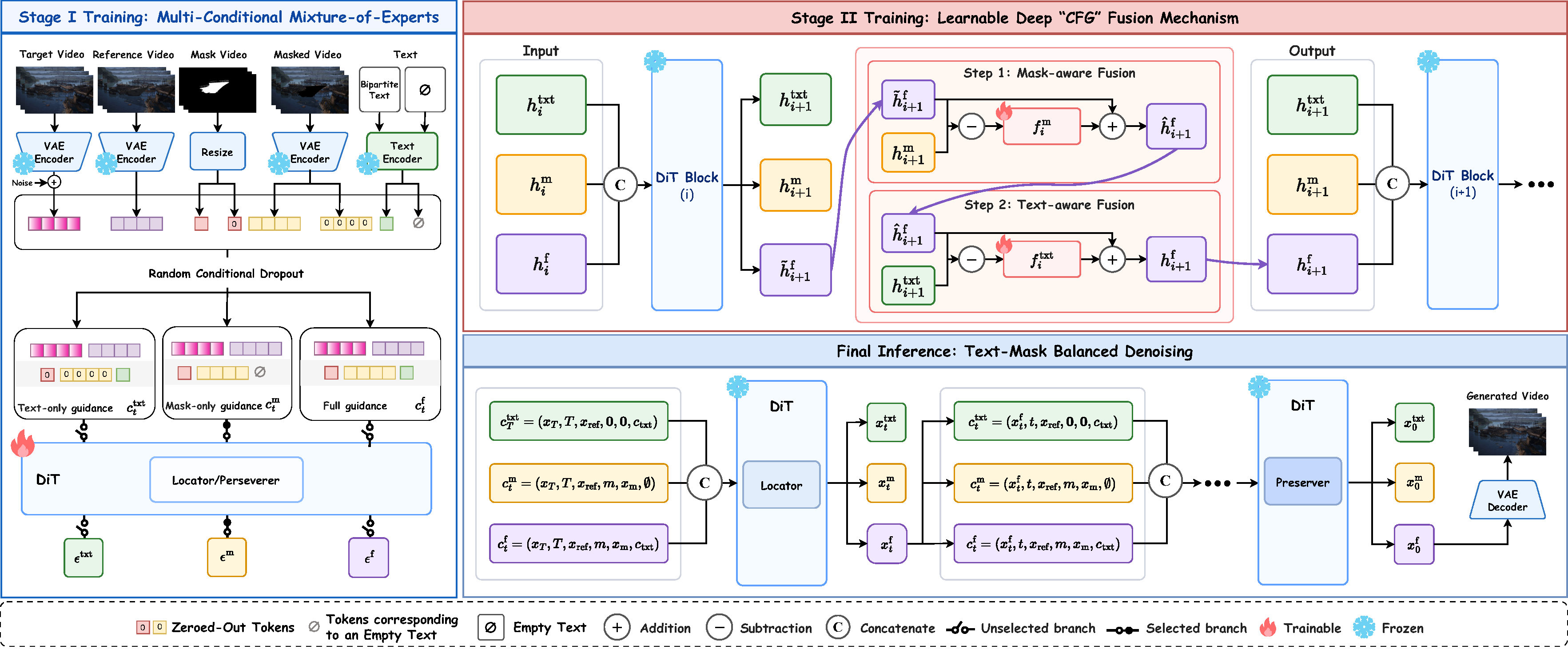
GenEraser method overview

GenEraser is trained using a two-stage procedure, as illustrated in the Figure. The first stage trains the Multi-Conditional Mixture-of-Experts mechanism using random conditional dropout to enhance model alignment with mask and text conditions, thereby improving overall generalization. Subsequently, the second stage trains the Learnable Deep CFG Fusion module deterministically across three branches to balance the relative dominance of textual and mask guidance across diverse scenarios. Both the Locator and the Preserver follow this two-stage training procedure, while differing in their training configurations and injected noise levels. Finally, during inference, only the output corresponding to full guidance is utilized for subsequent denoising.